
Natur am Byth!
Many plants are special to Wales. Some of them are vulnerable and could even become extinct. It is these gems which Plantlife Cymru is working to save as part of the Natur am Byth! flagship project. This larger project unites nine environmental charities (of which Plantlife Cymru is one) with Natural Resources Wales (NRW) to deliver the country’s largest natural heritage and outreach programme to save species from extinction and reconnect people to nature. We are running two projects within the Natur am Byth project.

- Go to:
Tlysau Mynydd Eryri/Eryri’s Mountain Jewels

In this project we are working in one of the richest areas for mountain plants in Britain south of the Scottish Highlands. Project Officer Robbie Blackhall-Miles is working to save 14 species, which include montane flowering plants and ferns, a tree and an insect, from extinction in Wales.
Tlysau Mynydd Eryri Species
The rare species we’re working to save
• Persicaria vivipara
• Alpine Mouse-ear – Cerastium alpinum – Clust-y-llygoden Alpaidd
• Alpine Saw-wort – Saussurea alpina – Lliflys y mynydd
• Alpine Woodsia – Woodsia alpina – Rhedynen-woodsia Alpaidd
• Pisidium coventus
• Holly Fern – Polystichum lonchitis – Rhedynen Gelyn
• Irish Saxifrage – Saxifraga rosacea – Tormaen Iwerddon
• Mountain Avens – Dryas octopetala – Derig
• Oblong woodsia – Woodsia silvensis – Rhedynen-woodsia Hirgul
• Snowdon Hawkweed – Hieracium snowdoniense – Heboglys yr Wyddfa
• Tufted Saxifrage – Saxifraga cespitosa – Tormaen Siobynnog
• Common Juniper – Juniperus communis – Merywen
• Snowdon Beetle – Chrysolina cerealis – Chwilen yr Wyddfa

A team effort
In the Tlysau Mynydd Eryri project Robbie Blackhall-Miles is working with volunteers, mountain guides, local plant nurseries, land managers and botanical experts. Together they are painstakingly turning around the fortunes of these rare mountain species and setting them on the road to recovery. Along the way they are celebrating these beautiful mountain jewels and the landscapes they live in.

The challenges
The selected species are rare because they have, and continue to, face many challenges. Tourists in the Victorian era indulged in the fashion of collecting ferns and montane plants which reduced their numbers substantially. More recently farming practice and the way the land is used has changed out of all recognition. Today air-borne pollution, in particular nitrogen, together with climate change are making life very difficult for these clean air and cold loving plants.
Welsh Marches

The Welsh Marches/Gororau Cymru project
This project is saving very rare lichens and bryophytes living on veteran trees and dry rocky outcrops and hilltops in an area stretching from near Presteigne, Radnorshire to Gregynog near Newtown. Project officer Ellie Baggett is working to revive populations of 15 species which include some of our rarest lichens, mosses and 3 insect species.
Welsh Marches Species
The rare species we’re working to save
• Scarce Cardinal Beetle – Schizotus pectinicornis – Chwilen ysgarlad,
• a Firedot lichen – Caloplaca lucifuga
• Circumspect Dotted Lichen – Scutula circumspecta
• Prysgwydden y Coed – Anaptychia ciliaris ciliaris – Eagle’s Claw
• Geranium Firedot Lichen – Caloplaca herbidella
• Lecanographa amylacea – a lichen
• Buellia violaceofusca – a lichen
• Sap-groove Lichen – Bellicidia incompta
• Horsehair lichen – Bryoria fuscescens
• Black Crystalwort – Riccia nigrella – Grisial-lys Du
• Dog Screw-moss – Tortula canescens – Mwsogl troellog
• Upright Apple-moss – Bartramia aprica – Afal-fwsogl
• Oak Polypore – Buglossoporus quercinus -Ysgwydd y Derw
• Wasp-banded Comb-horn Cranefly – Ctenophora flaveolata – Pryf Teiliwr
• a false darkling beetle – Hypulus quercinus – Chwilen saprosylig

Working with farmers
In the Welsh Marches Ellie Baggett is working with farmers and local communities to develop and put into action various practical techniques. These include clearing scrub – bushes, bracken and rank grass – so that the light loving lichens can thrive. She is also encouraging farmers to care for their veteran trees so that the lichen and moss which depend on them survive. By planting trees in the right places, Ellie hopes in years to come they will become veteran trees and provide habitats for these lichens.

The challenges
Several factors mean the selected rare lichen, moss and insect species are in danger of extinction. Some of them are actually adapted to the climate of the Mediterranean, and are near the northern limit of their global range in Wales. In some places there’s too much growth from adjacent vegetation which stops sunlight from reaching the specific lichen or moss. Elsewhere it is the veteran trees which provide the lichen or moss species with homes, which are themselves at risk of falling in storms. Another threat comes from the air, since many of the lichen species are sensitive to nitrogen pollution.
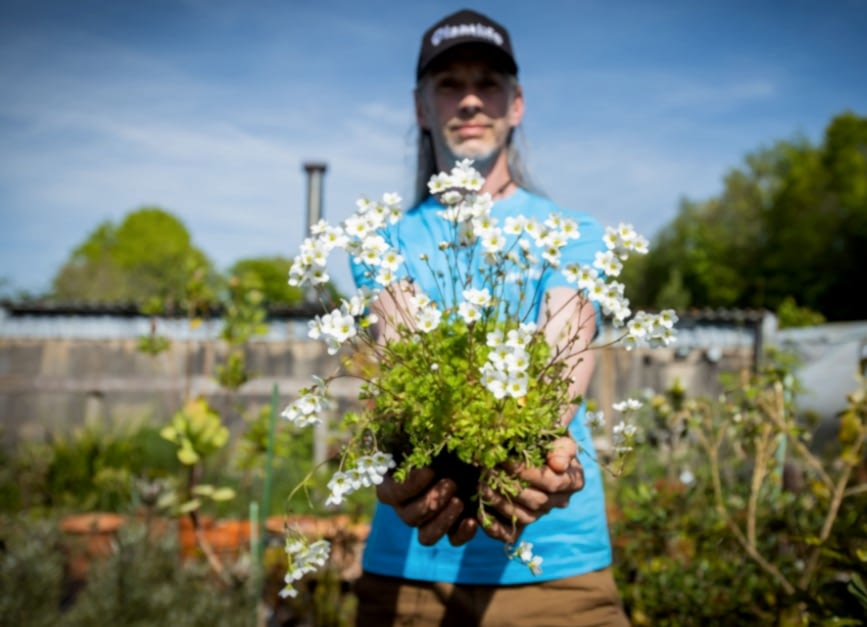
Extinct montane plant reintroduced to Wales
Through the Tlysau Mynydd Eryri partnership project, the beautiful Rosy Saxifrage has been reintroduced to Wales, more than six decades after becoming extinct.
The Arctic alpine plant was last seen on cliff edges in the Eryri (Snowdonia) region in 1962. Now plants that have direct lineage to these specimens are blooming once again, close to where they were last recorded.
Read more here.
Watch as Robbie reintroduces this plant back to the crags of Cwm Idwal and learn more about the project and this special plant.
The Wider Natur am Byth Project

Our work is just one part of the wider Natur am Byth! programme. The 67 target species were chosen as a result of culmination of a major piece of work to establish those that are facing the greatest threat of extinction, and are of particular importance to Wales. This was informed by the Environment (Wales) Act section 7 list, and through consultation with natural heritage experts across Wales and the UK.
Image: Survey work in Eryri © Lizzie Wilberforce – Plantlife
Find out more about our work in Wales here.
Natur am Byth! Project Overview
Through the Natur am Byth! We will:
- Put the risks to threatened species on the agenda and show why it matters
- Demonstrate how to save Wales’ most endangered species and help them to recover through resilient ecosystems
- Inspire people in Wales from all walks of life to take action and mobilise diverse communities to care for the wildlife on their doorstep
- Help a new wave of conservation ambassadors and practitioners to emerge
- Collaborate to find solutions to the most pressing issues for species conservation in Wales
- Provide support to our partners on work relating to vascular plants, lichens and bryophytes
The full list of landscapes in which Natur am Byth! is active is:
- Llŷn peninsula and Ynys Môn (Anglesey)
- Pembrokeshire
- Gower and Swansea City
- Neath Port Talbot and Bridgend
- Vale of Glamorgan
- Cardiff and Newport Gwent Levels
- Snowdonia
- Powys
Find out more about the project and how to get involved:
- About the wider Natur am Byth programme across Wales: Natural Resources Wales / Natur am byth! Saving Wales’ threatened species
- About Plantlife’s project work in Eryri and the Marches: email us at [email protected]
We welcome hearing from anyone who would like to speak to us about the programme or help us to shape it. You can email the Plantlife Cymru team about the project on [email protected]
Who are we working with?
Funding
Work on the programme started in 2023, and will continue until the summer of 2027.
The partnership has budgeted total programme costs at £8m.
Thanks to players of the National Lottery, we have secured £4.1m delivery phase funding from National Lottery Heritage Fund.
NRW has contributed £1.7m and the Natur am Byth partners have secured a further £1.4m from Welsh Government, Arts Council of Wales and a number of charitable trusts, foundations, and corporate donors. These include donations from the Esmée Fairbairn Foundation, and significant support from Welsh Government’s Landfill Disposals Tax Communities Scheme administered by Wales Council for Voluntary Action (WCVA).
With thanks to the following funders:

Learning About Our Mountain Environment
Tlysau Mynydd Eryri will also collect data about some of our scarcest species to inform habitat restoration at scale.
Did you know that on the high peaks of Yr Wyddfa (Snowdon) and on the Glyderau there grows a forest that is little more than a foot high? A forest of Juniper nestled among the rocks in the crags and crevices.
A recent study undertaken in conjunction with Tlysau Mynydd Eryri and Bangor University used the fragmented records of trees that still exist on Eryri’s high peaks, historic literature, and evidence from peat cores, to piece together what the composition of this woodland may have been in Wales.
What the study found was a complex mosaic woodland made of:
Downy birch Betula pubescens, Alder Alnus glutinosa, Hazel Corylus avellana, Goat Willow Salix caprea, Grey Willow Salix cinerea, Rusty Willow Salix cinerea subsp. oleifolia, Creeping Willow Salix repens, Eared Willow Salix aurita, Aspen Populus tremula, Dwarf Willow Salix herbacea, Juniper Juniperus communis subsp. nana, Mountain Avens Dryas octopetala, Sweet Briar Rosa rubiginosa, Burnet Rose Rosa spinosissima, and Wild Raspberry Rubus idaeus.
The trees of Eryri are still under recorded and the records of trees in the high mountains are limited. Alpine Juniper Juniperus communis subsp. nana is the most recorded tree in the uplands of Wales due to some targeted survey work that took place in the 1990s. Discover more about these miniature forests in a blog by Robbie Blackhall-Miles here.