Narrow-leaved Water-dropwort
Oenanthe silaifolia
Months
Season
Colour
Habitat
Status
How to Identify:
| Annual/Perennial/Biennial | Perennial |
| Height | Up to 1 metre high |
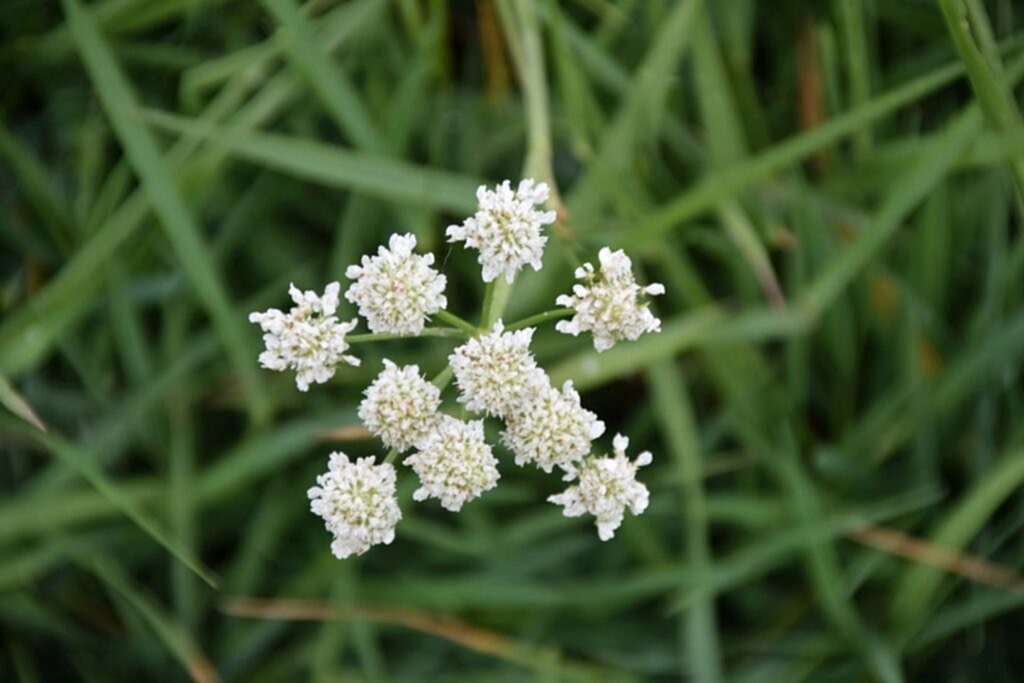
| Flower type | Has 4-8 smaller rounded, umbrella shaped flower clusters about 2 cm in diameter. Each tiny flower has 5 unequal petals with the outer ones slightly larger. |
| Leaves | Leaves branched 1 to 4 times |
| Stems | Hollow stem with thin walls |
How to Spot Narrow-leaved Water-dropwort
This is not an easy plant to easily identify because it looks like a lot of other ‘umbellifers’, plants topped by a mass of frothy white flowers such as Cow Parsley, Wild Carrot and Hogweed. But there are a few clues to help you find it.
First, like the other six native species of Water-dropwort in the UK, it is found in wet places. But this species is particularly associated with floodplain meadows where its tall, hollow, grooved, thin stems can reach up higher than most surrounding wildflowers. These are topped by 4-8 roundish masses of white flowers known as umbels, each lacking modified leaves (bracts) beneath the umbel.
Below ground, it has thick spindle shaped tubers.

Where to Find Narrow-leaved Water-dropwort
As floodplain meadows have dramatically disappeared from the British countryside, so has Narrow-leaved Water-dropwort. There are only an estimated 1,100 hectares of water meadows remaining in England and Wales, less than the size of Heathrow Airport, but there are causes for optimism as society is waking up to the sustainable benefits of these special habitats. These irreplaceable meadows are incredible carbon stores and flood defences, as their deep and absorbent soils hold and slow the flow of flood water.
A heartening example is Lugg Meadow, one of the UK’s most important and historic floodplain meadows. The only known stronghold for Narrow-leaved Water-dropwort in Herefordshire, the county Wildlife Trust is currently delivering a Natural England Species Recovery project to secure the plant’s future on the meadow. Also found on stream sides, and Narrow-leaved Water-dropwort known to colonise restored wet grassland on habitat restoration schemes.
Ellie Chowns MP, is currently working with us as a Species Champion to raise awareness of Narrow-leaved Water-dropwort and its causes of decline.
Find out more about Species and Nature Champions here.
Fun Facts About Narrow-leaved Water-dropwort
- Lugg Meadow has been managed as a water meadow since at lest the time of the building of Hereford Cathedral around a 1000 years ago
- Its nectar feeds all kinds of insects but the caterpillar of the parsnip moth is the only insect known to feed on the leaves and stem of the Narrow-leaved Water-dropwort in Britain
- It wasn’t until 1819 that this plant was first described in print. This was done by a German botanist with the rather grand name of Friedrich Augusr Marschall von Bieberstein
- Narrow-leaved Water-dropwort has its own official champion in Parliament, Dr Ellie Chowns MP for North Herefordshire
- A “dropwort” is a plant with drop-shaped tubers.